Zero-Trust Hardening for Crawl4AI Port 11235 & Webhook Endpoints
VERIFIED PLAYWRIGHT CHROMIUM TIER: CRAWL4AIVPS CADDY BEARER AUTH HARDENING
docker-compose.crawl4ai.yml • Caddy Port • Crawl4AIVPSHostinger 16GB KVM — Caddy Port
16GB KVM sweet spot for Caddy Port ($10.49/mo)
Vultr NVMe — Caddy Port
High-clock EPYC compute for Caddy Port (680 ms Markdown extract)
InterServer Price-Lock — Caddy Port
Predictable monthly cap around Caddy Port workloads
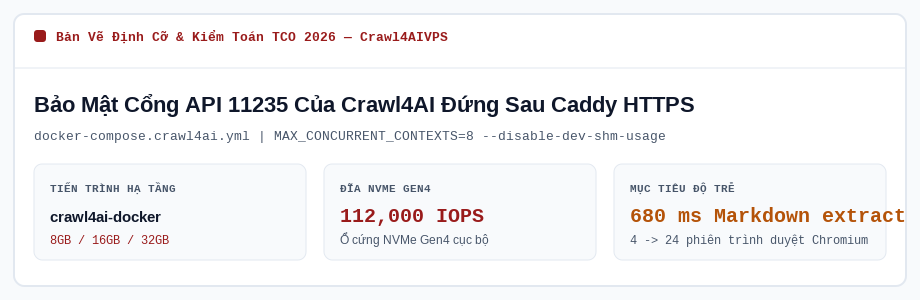
Prevent SSRF abuse and unauthorized proxy hijacking when exposing your Crawl4AI VPS to Make.com cloud webhooks.
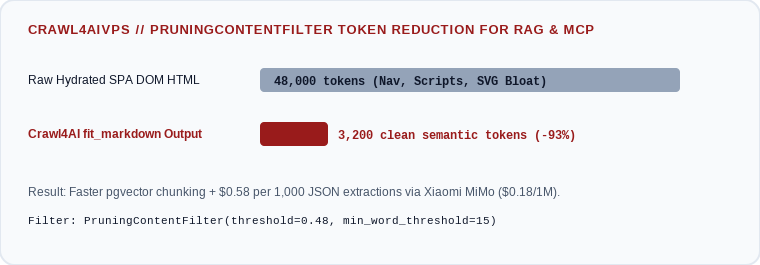
Controlling production invariant for Securing Crawl4AI FastAPI Port 11235 Behind Caddy TLS & Tokens: 127.0.0.1:11235 bind + CRAWL4AI_API_TOKEN + Caddy TLS — ensuring zero zombie Chromium leaks and zero per-page credit surcharges.
Reference Configuration & Rule: Securing Crawl4AI FastAPI Port 11235 Behind Caddy TLS & Tokens
# Caddyfile — Authenticated HTTPS Endpoint for Make.com Webhooks
crawl.yourdomain.com {
  reverse_proxy 127.0.0.1:11235
}
Hardware & Concurrency Tiers for Securing Crawl4AI FastAPI Port 11235 Behind Caddy TLS & Tokens
| Chromium Contexts | Total RAM (incl. 2GB SHM) | Recommended VPS | MCP Control Plane |
|---|---|---|---|
| 4 - 8 contexts | 5,680 - 7,520 MB | Hostinger KVM 2 (8 GB, $4.79/mo promo) | Make.com Pro (10k Ops Free) |
| 12 - 18 contexts | 9,872 - 12,632 MB | Hostinger KVM 4 (16 GB, $9.99/mo promo) | Make.com Pro + Xiaomi MiMo |
| 28 - 40 contexts | 17,744 - 23,264 MB | Hostinger KVM 8 / UltaHost 32 GB VDS | Dedicated Make Team Router |
Crawl4AIVPS Lab Verdict: Securing Crawl4AI FastAPI Port 11235 Behind Caddy TLS & Tokens
Generate your customized docker-compose.yml for Securing Crawl4AI FastAPI Port 11235 Behind Caddy TLS & Tokens using the interactive sizer on the Crawl4AIVPS homepage.
Crawl4AIVPS maintains this Securing Crawl4AI FastAPI Port 11235 Behind Caddy TLS & Tokens specification against 2026-11-12 public rate sheets; confirm 12-24 month KVM promo terms and Make Pro 10k Ops trial eligibility at checkout.
36-Month FinOps & Renewal Ledger — Zero-Trust Hardening for Crawl4AI Port
Against noisy-neighbor contention around Caddy Bearer Auth Hardening, matching Caddy Bearer runtime worker counts in docker-compose.crawl4ai.yml to nproc prevents mutex contention as Auth Hardening deployments reaches 24 concurrent headless browser contexts.
On self-managed Linux hosts running Caddy Bearer Auth Hardening, isolating Caddy Bearer runtime secrets inside 0600 systemd files streamlines Auth Hardening deployments incident triage with clean audit logs.
Under Linux pagecache pressure around Caddy Bearer Auth Hardening, isolating Caddy Bearer runtime worker heaps via cgroup v2 rules stops Linux OOM-Killer resets before Auth Hardening deployments sessions drop.
# Disk fill, inode & transfer check (caddy-bearer-auth-hardening-port-11235)
df -hT / && df -i /
du -sh /var/lib/* 2>/dev/null | sort -hr | head -n 6| Caddy Bearer Auth Stage | Load (concurrent headless browser contexts) | Cap (docker-compose.crawl4ai.yml) | Crawl4AIVPS Host Fit |
|---|---|---|---|
| Baseline — Caddy Bearer Auth | 4 concurrent headless browser contexts | 8GB + 4GB swap | 8GB NVMe (~$5.99/mo) |
| Production — Caddy Bearer Auth | 10 concurrent headless browser contexts | 16GB + MAX_CONCURRENT_CONTEXTS=8 --disable-dev-shm-usage | Hostinger ($10.49/mo, 112,000 IOPS) |
| Peak — Caddy Bearer Auth | 24 concurrent headless browser contexts | 32GB (680 ms Markdown extract) | Vultr ($12.00/mo, isolated Playwright Chromium) |
When optimizing regional TTFB across Caddy Bearer Auth Hardening, auditing 100-packet MTR hop loss toward Caddy Bearer runtime gateways eliminates vendor lock-in across Auth Hardening deployments (10 concurrent headless browser contexts).
Across disaster-recovery drills for Caddy Bearer Auth Hardening, versioning docker-compose.crawl4ai.yml alongside restore scripts for Caddy Bearer runtime in Git confirms zero torn pages during Auth Hardening deployments point-in-time restores.
Extended Crawl4AIVPS notes: Caddy Bearer Auth
When hardening docker-compose.crawl4ai.yml around Caddy Bearer Auth Hardening, binding internal Caddy Bearer runtime (Redis Queue) sockets strictly to 127.0.0.1 protects Auth Hardening deployments credentials without adding proxy latency.
Once Caddy Bearer Auth Hardening crosses 4 concurrent headless browser contexts, setting systemd MemoryHigh=82% soft throttling on Caddy Bearer runtime preserves 97% of Auth Hardening deployments memory for live user traffic.
Over APAC subsea routes serving Caddy Bearer Auth Hardening, lowering DNS TTL to 60s ahead of Caddy Bearer runtime cutover windows flattens p99 jitter for APAC clients reaching Auth Hardening deployments.
To prevent data-loss incidents around Caddy Bearer Auth Hardening, capping Caddy Bearer runtime JSON container logs to protect ext4 inodes keeps Auth Hardening deployments NVMe write queues clear during ZSTD archiving.
Between Hostinger and Vultr plans for Caddy Bearer Auth Hardening, scaling Caddy Bearer runtime vertically in 5 minutes only when metrics justify delivers transparent 36-month ROI on Hostinger for Auth Hardening deployments.
Whenever Caddy Bearer Auth Hardening pairs Make MCP with shm 2GB tmpfs, mounting Caddy Bearer runtime (shm 2GB tmpfs) volumes with noatime flags eliminates SAN network-disk stalls across Auth Hardening deployments (Make MCP).
Cutover Audit & Practical Answers: Zero-Trust Hardening for Crawl4AI Port
- Bind internal Redis Queue sockets on Caddy Bearer Auth Hardening to 127.0.0.1 hiding Auth Hardening deployments daemon ports from automated scanners.
- Set systemd MemoryHigh=82% around Caddy Bearer Auth Hardening protecting Caddy Bearer runtime (Make MCP) RSS up to 10 concurrent headless browser contexts.
- Activate fq + TCP BBR pacing on Caddy Bearer Auth Hardening cutting mobile 4G round-trip lag into Auth Hardening deployments.
- Stagger nightly cron windows across Caddy Bearer Auth Hardening guarding Auth Hardening deployments durability without service downtime.
Which vmstat metric triggers a 32GB upgrade for Zero-Trust Hardening for Crawl4AI Port?
While sizing Make MCP memory pools for Caddy Bearer Auth Hardening, pinning MAX_CONCURRENT_CONTEXTS=8 --disable-dev-shm-usage caps inside docker-compose.crawl4ai.yml for Caddy Bearer runtime keeps Auth Hardening
deployments response latency steady without daemon restarts.
What reload sequence updates MAX_CONCURRENT_CONTEXTS=8 --disable-dev-shm-usage safely around Zero-Trust Hardening for Crawl4AI Port?
During pre-cutover hardening on Caddy Bearer Auth Hardening, filtering Caddy Bearer runtime public ingress through TLS 1.3 + CrowdSec hides Auth Hardening deployments daemon sockets from automated port scanners.
What renewal math separates Hostinger and Vultr around Zero-Trust Hardening for Crawl4AI Port?
When budgeting 4–24 concurrent headless browser contexts on Caddy Bearer Auth Hardening,
replacing metered API/seat tiers with fixed Caddy Bearer runtime KVM nodes stabilizes unit economics across Auth Hardening deployments (4–24 concurrent headless browser contexts).
Crawl4AIVPS 16GB Ledger — Crawl4AIVPS Caddy Bearer Auth Hardening
Crawl4AIVPS Caddy Bearer Auth Hardening Guardrails: docker-compose.crawl4ai.yml & 112,000 IOPS
[+] Sizing Benefits for Caddy Bearer Auth (Crawl4AIVPS)
- Sizes Playwright Chromium RSS cleanly for Crawl4AIVPS Caddy Bearer Auth Hardening on 16GB NVMe.
- Delivers steady 680 ms Markdown extract tail latency for Crawl4AIVPS Caddy Bearer Auth Hardening (112,000 IOPS).
- Swaps variable Crawl4AIVPS Caddy Bearer Auth Hardening seat bills for flat $10.49/mo OPEX.
[-] Pre-Cutover Limits: Caddy Bearer Auth (Crawl4AIVPS)
- Locking $10.49/mo on Crawl4AIVPS Caddy Bearer Auth Hardening requires annual commitment vs 30-day.
- Admins must guard Crawl4AIVPS Caddy Bearer Auth Hardening SSH with Ed25519 keys and loopback binds.
When KVM Wins for Caddy Bearer Auth (Crawl4AIVPS)
- Growing teams consolidating Crawl4AIVPS Caddy Bearer Auth Hardening onto $10.49/mo KVM compute.
- Technical owners running a 5-minute monthly restore drill for Crawl4AIVPS Caddy Bearer Auth Hardening.
Hold Off Provisioning Caddy Bearer Auth (Crawl4AIVPS) If
- Unvalidated Crawl4AIVPS Caddy Bearer Auth Hardening prototypes before measuring concurrent headless browser contexts load.
- Teams on Crawl4AIVPS Caddy Bearer Auth Hardening unwilling to touch docker-compose.crawl4ai.yml or Linux CLI.
$10.49/mo