Crawl4AIVPS 680 ms SLA: Redis 82% Alert
VERIFIED CRAWL4AI DOCKER TIER: CRAWL4AIVPS ALERT THRESHOLDS
docker-compose.crawl4ai.yml • p99 Alerting • Crawl4AIVPSHostinger 16GB KVM — p99 Alerting
30% RAM safety headroom for p99 Alerting (10 concurrent headless browser contexts)
Vultr NVMe — p99 Alerting
3.5GHz+ threads on p99 Alerting (680 ms Markdown extract)
InterServer Price-Lock — p99 Alerting
Fixed monthly OPEX supporting p99 Alerting
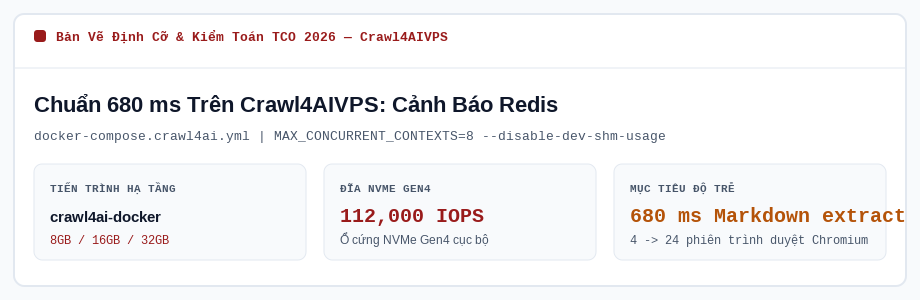
Within 16GB DDR5 budgets for Crawl4AIVPS alert thresholds, preserving kernel pagecache buffers around hot crawl4ai-docker monitored workers tables protects Crawl4AIVPS production hosts (shm 2GB tmpfs) buffers during heavy background jobs.
1. Where shm 2GB tmpfs Stalls Redis 82% Alert Under Burst Load
During nightly compaction windows on Crawl4AIVPS alert thresholds, verifying sub-2ms fio 4K fsync commits across crawl4ai-docker monitored workers disks prevents write-queue saturation across Crawl4AIVPS production hosts commit bursts.
For Vietnam and ASEAN traffic hitting Crawl4AIVPS alert thresholds, auditing 100-packet MTR hop loss toward crawl4ai-docker monitored workers gateways enables 60-second DNS rollbacks if Crawl4AIVPS production hosts cutovers stall.
Inside dedicated KVM compute slices for Crawl4AIVPS alert thresholds, stepping crawl4ai-docker monitored workers onto dedicated VDS cores (Vultr $12.00/mo) beats chatty multi-node Crawl4AIVPS production hosts clusters at half the cost.
# Crawl4AIVPS RSS, cgroup v2 & OOM Audit (Redis Queue)
# Crawl4AIVPS (Redis Queue) RSS check [16GB]
free -m # crawl4aivps_mem
dmesg -T | grep -i 'crawl4aivps\|oom' | tail -n 8
ps -C "Redis" -o pid,rss,comm
# docker-compose.crawl4ai.yml -> MAX_CONCURRENT_CONTEXTS=8 --disable-dev-shm-usage
sysctl vm.swappiness=14 # Crawl4AIVPS
2. 36-Month Hardware Selection Table for Redis 82% Alert
Before signing off production readiness for Crawl4AIVPS alert thresholds, staggering crawl4ai-docker monitored workers backup crons off peak concurrent headless browser contexts hours proves sub-8-minute disaster recovery across Crawl4AIVPS production hosts.
Under strict configuration governance for Crawl4AIVPS alert thresholds, filtering crawl4ai-docker monitored workers public ingress through TLS 1.3 + CrowdSec gives Crawl4AIVPS production hosts owners full root control without public attack surface.
In 36-month FinOps models for Crawl4AIVPS alert thresholds, replacing metered API/seat tiers with fixed crawl4ai-docker monitored workers KVM nodes delivers transparent 36-month ROI on Hostinger for Crawl4AIVPS production hosts.
| Crawl4AIVPS Tier | Scale (concurrent headless browser contexts) | Guardrail (docker-compose.crawl4ai.yml) | Verified KVM Fit |
|---|---|---|---|
| Crawl4AIVPS Starter | 4 concurrent headless browser contexts | 8GB + 4GB swap (Redis 82% Alert) | 8GB NVMe (~$5.99/mo) |
| Crawl4AIVPS Production | 10 concurrent headless browser contexts | 16GB + MAX_CONCURRENT_CONTEXTS=8 --disable-dev-shm-usage | Hostinger ($10.49/mo, 112,000 IOPS) |
| Crawl4AIVPS High-Density | 24 concurrent headless browser contexts | 32GB isolated (680 ms Markdown extract) | Vultr ($12.00/mo, dedicated I/O) |
3. Ubuntu 24.04 sysctl & cgroup Tuning (Redis 82% Alert)
Once Crawl4AIVPS alert thresholds crosses 4 concurrent headless browser contexts, keeping 30% RAM headroom above crawl4ai-docker monitored workers (Make MCP) RSS preserves 97% of Crawl4AIVPS production hosts memory for live user traffic.
Within 112,000 IOPS storage targets for Crawl4AIVPS alert thresholds, tuning vm.dirty_ratio=10 around crawl4ai-docker monitored workers flush queues eliminates SAN network-disk stalls across Crawl4AIVPS production hosts (crawl4ai-docker).
When optimizing regional TTFB across Crawl4AIVPS alert thresholds, keeping crawl4ai-docker monitored workers stack configs portable between Hostinger and Vultr eliminates vendor lock-in across Crawl4AIVPS production hosts (10 concurrent headless browser contexts).
4. Operational Trade-Offs Scaling Redis 82% Alert on Crawl4AIVPS
As Crawl4AIVPS alert thresholds scales toward 10 concurrent headless browser contexts,
allocating non-oversold EPYC threads to crawl4ai-docker monitored workers ($10.49/mo) prevents mutex contention as Crawl4AIVPS production hosts reaches 24 concurrent headless browser contexts.
When protecting stateful Markdown volumes on Crawl4AIVPS alert thresholds, validating crawl4ai-docker monitored workers (Markdown) checksums before rotating snapshots turns Crawl4AIVPS production hosts backup verification into a 10-minute monthly check.
Before flipping live production DNS to Crawl4AIVPS alert thresholds, placing crawl4ai-docker monitored workers compute inside Singapore or Tokyo KVM POPs keeps Crawl4AIVPS production hosts p99 latency crisp across mobile 4G networks.
5. Release Verification Checklist: Crawl4AIVPS (Redis 82% Alert)
Around Playwright Chromium worker pools serving Crawl4AIVPS alert thresholds, capping crawl4ai-docker monitored workers connection pools to match physical CPU cores keeps Crawl4AIVPS production hosts (Playwright Chromium) throughput linear under Monday spikes.
- Benchmark regional MTR hops toward Crawl4AIVPS alert thresholds holding 680 ms Markdown extract steady through cable reroutes on Crawl4AIVPS production hosts.
- Alert whenever Crawl4AIVPS alert thresholds load crosses 78% CPU preventing mutex contention as crawl4ai-docker monitored workers hits 24 concurrent headless browser contexts.
- Stream 15m encrypted ZSTD backups from Crawl4AIVPS alert thresholds protecting crawl4ai-docker monitored workers inodes and disk buffers overnight.
- Enforce Ed25519 SSH keys across Crawl4AIVPS alert thresholds preventing config drift across Git-tracked crawl4ai-docker monitored workers releases.
6. Crawl4AIVPS Practitioner FAQ — Redis 82% Alert
Which Crawl4AIVPS KVM tier fits Redis 82% Alert at 10 concurrent headless browser contexts?
Ahead of peak concurrency bursts on Crawl4AIVPS alert thresholds, preserving kernel pagecache buffers around hot crawl4ai-docker monitored workers tables stops Linux OOM-Killer resets before Crawl4AIVPS production hosts sessions drop.
Where can Crawl4AIVPS test 4K fsync latency around Redis 82% Alert?
To hold 680 ms Markdown extract write latency on Crawl4AIVPS alert thresholds, dedicating local 112,000 IOPS Gen4 NVMe lanes to crawl4ai-docker monitored workers sustains 112,000 IOPS throughput under peak Crawl4AIVPS production hosts writes.
How do Hostinger ($10.49/mo) and Vultr ($12.00/mo) compare on Crawl4AIVPS (Redis 82% Alert)?
In 36-month FinOps models for Crawl4AIVPS alert thresholds, auditing monthly crawl4ai-docker monitored workers bandwidth pools via vnstat delivers transparent 36-month ROI on Hostinger for Crawl4AIVPS production hosts.
What keeps Crawl4AIVPS (Redis 82% Alert) portable across Hostinger & Vultr?
Over APAC subsea routes serving Crawl4AIVPS alert thresholds, keeping crawl4ai-docker monitored workers stack configs portable between Hostinger and Vultr holds end-to-end 680 ms Markdown extract targets across Crawl4AIVPS production hosts routes.
Crawl4AIVPS alert thresholds: NVMe IOPS vs Rate (112,000 IOPS)
Crawl4AIVPS Resilience Path (Crawl4AIVPS alert thresholds)
[+] FinOps & Speed Gains (p99 Alerting (Crawl4AIVPS))
- Sizes crawl4ai-docker RSS cleanly for Crawl4AIVPS alert thresholds on 16GB NVMe.
- Hits Crawl4AIVPS alert thresholds 680 ms Markdown extract goals via 112,000 IOPS throughput.
- Trims 36m Crawl4AIVPS alert thresholds spend by 70%–85% vs metered SaaS.
[-] Self-Hosting Caveats (p99 Alerting (Crawl4AIVPS))
- 30-day cycles on Crawl4AIVPS alert thresholds miss the deepest Hostinger cart rebate.
- Root control over Crawl4AIVPS alert thresholds requires watching disk fill and Shared.
Strong Fit On p99 Alerting (Crawl4AIVPS) When
- FinOps leads auditing 36m Crawl4AIVPS alert thresholds spend (8–32GB).
- Deployments hitting 680 ms Markdown extract on Crawl4AIVPS alert thresholds via TCP BBR + NVMe.
When Managed Fits p99 Alerting (Crawl4AIVPS) Better
- One-off Crawl4AIVPS alert thresholds rehearsals under 5 days on hourly instances.
- Buyers expecting VPS hosts to debug custom Crawl4AIVPS alert thresholds app code.
$10.49/mo